
MAKE A SUBMISSION

ABOUT
TEMPLATE

SUPPORTING TOOLS


PUBLISHER

MEMBER OF

IN COLLABORATION WITH




INFORMATION
FLAG COUNTER
STATCOUNTER

CITATION METRICS
Review for This Journal
Thank you for your interest in serving as an anonymous reviewer for Generasi Pendidikan Dasar (GENFABET). Once registered, you will be considered a reviewer for manuscripts that match your academic background and research interests.
Generasi Pendidikan Dasar (GENFABET) is a peer-reviewed journal that focuses on scientific discussion and research related to basic education. The journal provides a platform for sharing original research and ideas that support the development of theory, practice, and innovation in elementary education, including learning practices, curriculum development, child development psychology, educational technology, and educational policy.
Reviewers of GENFABET are entitled to the following benefits:
For more detailed information, please refer to the Call for Reviewer flyer
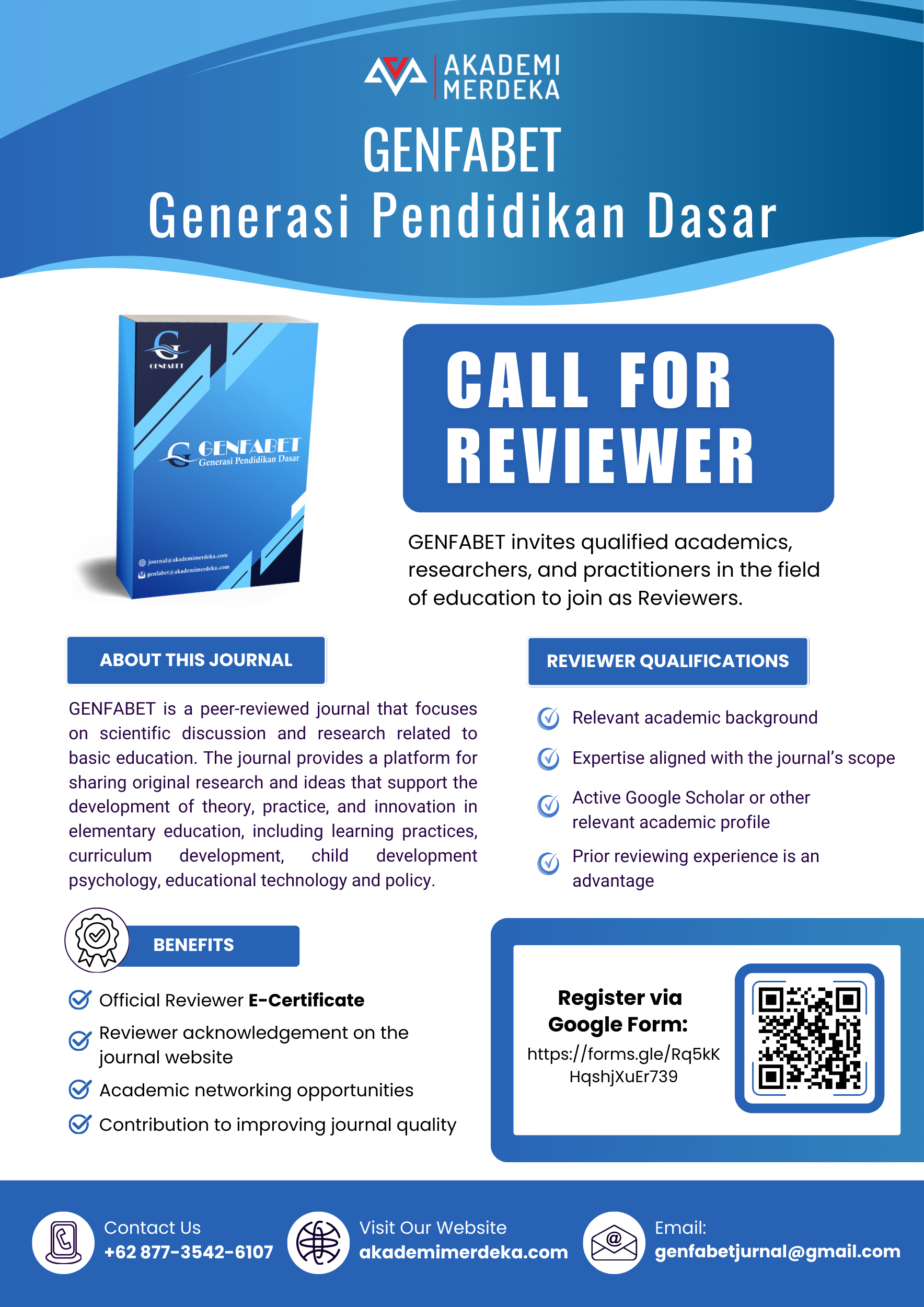
Reviewer registration is available at: Register as Reviewer
Reviewer Guidelines
GENFABET advises reviewers to adhere to the following guidelines when reviewing manuscripts submitted to the journal. The purpose of peer review is to ensure the academic quality, integrity, and relevance of manuscripts while providing constructive feedback to authors.
General Principles of Review
Conflict of Interest: reviewers must ascertain the absence of any potential conflict of interest related to the manuscript under review. If a conflict of interest exists, reviewers must promptly inform the editor and decline the review request.
Relevance to Journal Scope: reviewers should evaluate whether the topic and field of study of the manuscript align with the aims and scope of GENFABET: Generasi Pendidikan Dasar.
Ethical and Guideline Compliance: reviewers are expected to assess whether the manuscript complies with the journal’s Author Guidelines and adheres to accepted ethical standards of scholarly publication.
Scholarly Quality Assessment: reviewers must critically assess the manuscript’s originality, significance, novelty, methodological rigor, data quality, use of references, clarity of presentation, strength of discussion, accuracy of conclusions, and appropriateness of language.
Constructive and Objective Reporting: reviewers are required to provide an evaluation report that is unbiased, clear, and constructive, offering specific comments and actionable suggestions to improve the manuscript.
Reviewer Recommendation Categories
Reviewers are asked to select one of the following recommendations based on the academic validity and quality of the manuscript:
Accept: the manuscript is scientifically sound and requires no or only very minor revisions.
Minor Revision: the manuscript has academic merit but requires small revisions for clarity, completeness, or presentation.
Major Revision: the manuscript shows potential but requires substantial revisions related to methodology, analysis, interpretation, or structure.
Reject: the manuscript has fundamental flaws that undermine its academic validity and is not suitable for publication in its current form.
Resubmit for Review: the manuscript cannot be accepted or rejected at this stage but demonstrates scientific potential. The authors are required to undertake major revisions, and the resubmitted manuscript will be processed as a new submission and undergo a full peer review process.
Guiding Questions for Manuscript Review
Reviewers are encouraged to use the following questions to guide their assessment:
Reviewer Report
Reviewers are encouraged to:
All reviewer comments should be written in a professional and collegial manner.
MAKE A SUBMISSION
ABOUT
TEMPLATE
SUPPORTING TOOLS
PUBLISHER
MEMBER OF
IN COLLABORATION WITH
INFORMATION
FLAG COUNTER
STATCOUNTER
CITATION METRICS

GENFABET: Generasi Pendidikan Dasar
Published by CV. Akademi Merdeka
(eISSN: 3063-7015)
Copyright © 2024-2026, All rights reserved.
This is an open-access article licensed and distributed under the terms of the Creative Commons Attribution-ShareAlike 4.0 International

This work is licensed under a Creative Commons Attribution-ShareAlike 4.0 International